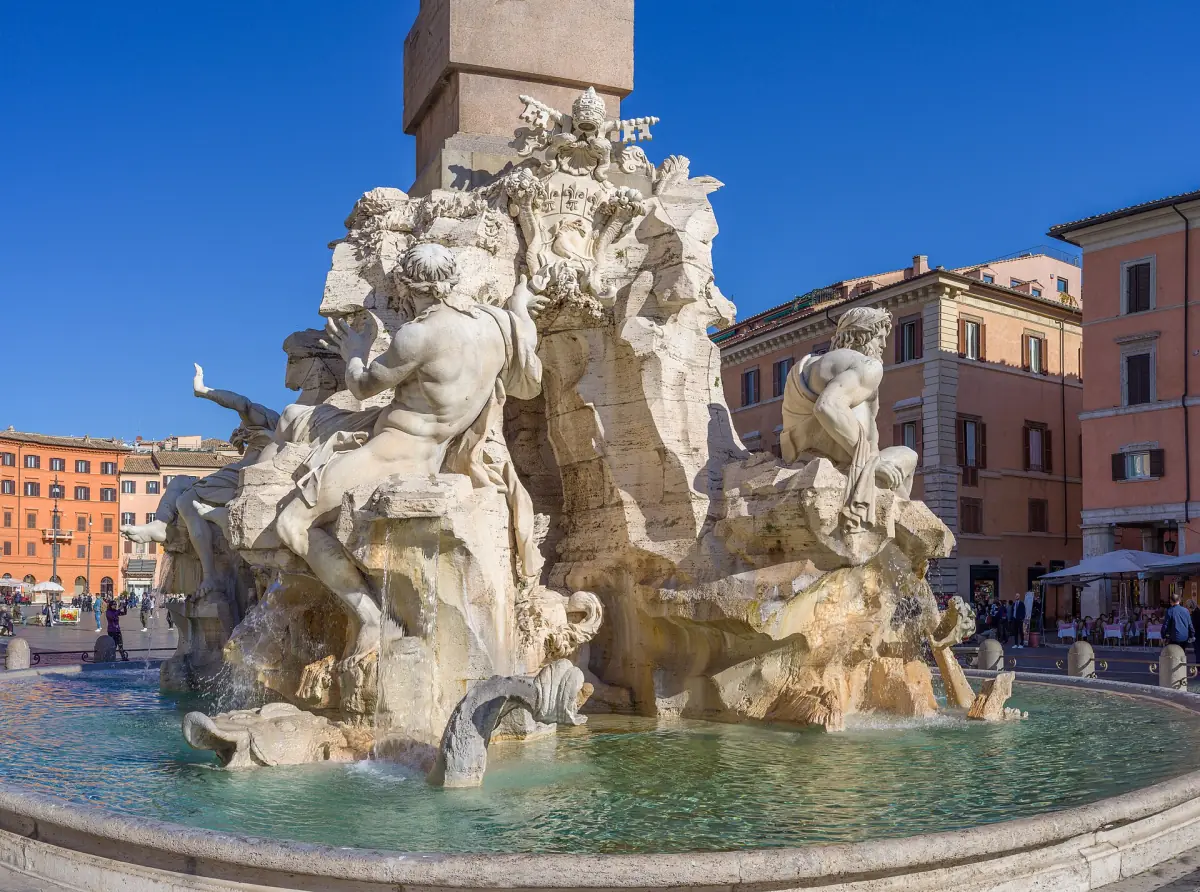
Bernini's fountain in the middle of the square
The Fountain of the Four Rivers is the centerpiece of Piazza Navona. Gian Lorenzo Bernini made the design, and several sculptors carried it out between 1648 and 1651 for Pope Innocent X Pamphilj. That detail matters: the design is Bernini's, but not every figure is his own hand.
A hollowed-out rock of travertine carries a granite obelisk. Around the rock sit four river gods, each for one continent. The Pamphilj coat of arms and a bronze dove with an olive branch on top mark the pope who ordered the fountain. It is the biggest of the three fountains on the square and the one that most visitors come to see.
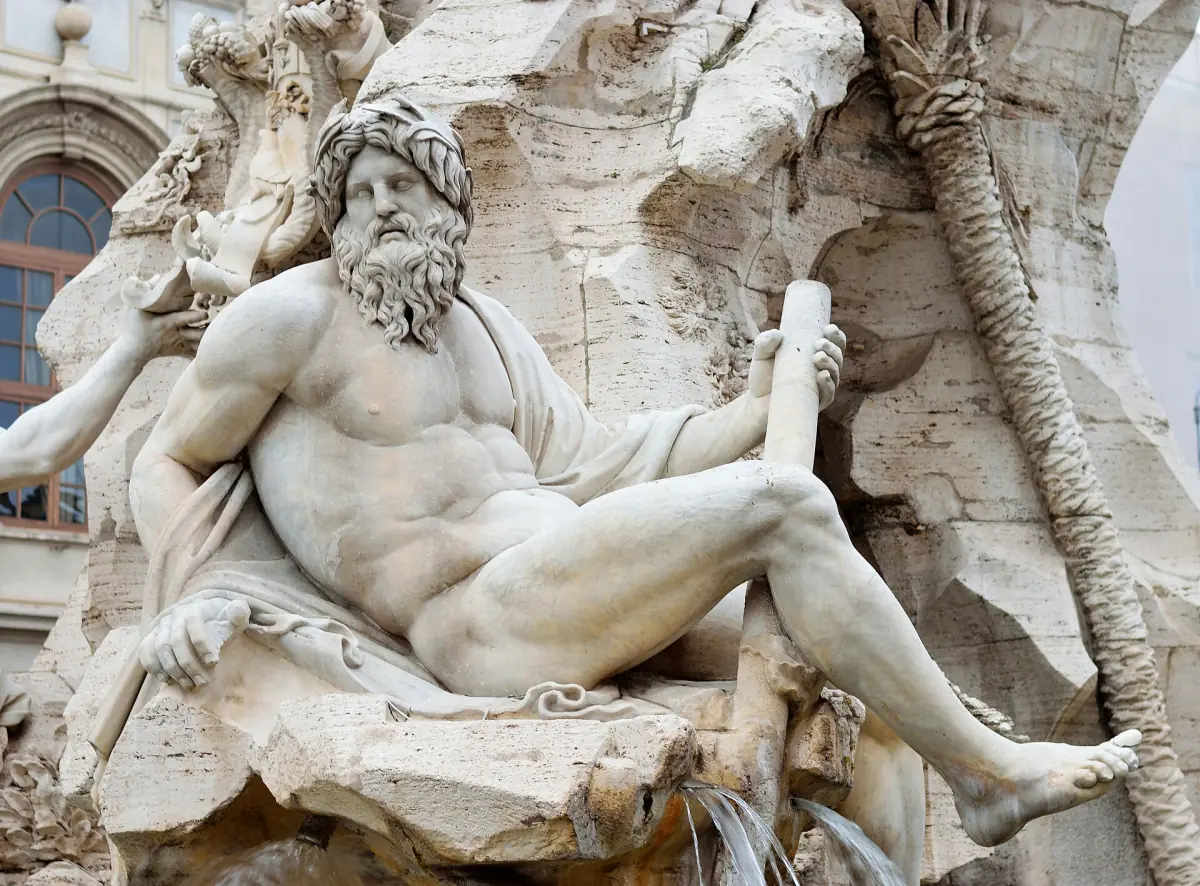
The four rivers and their sculptors
Each river stands for a continent.
| River | Continent | Sculptor |
|---|---|---|
| Danube | Europe | Antonio Raggi |
| Ganges | Asia | Claude Poussin |
| Nile | Africa | Giacomo Antonio Fancelli |
| Río de la Plata | The Americas | Francesco Baratta |
The figures use the picture language of the 17th century. The Nile has a veiled head, which points to the sources that were unknown then. The Ganges holds an oar. This is symbolism of the baroque age, not a record of travel.
Our picks: walks past the fountain
Guided walks through the centre that pass Bernini's fountain on Piazza Navona.
Hand-picked tours, booked through GetYourGuide. Prices are indicative starting prices in euros (as of October 2026). Tap a tour for live availability and the current price in your currency.
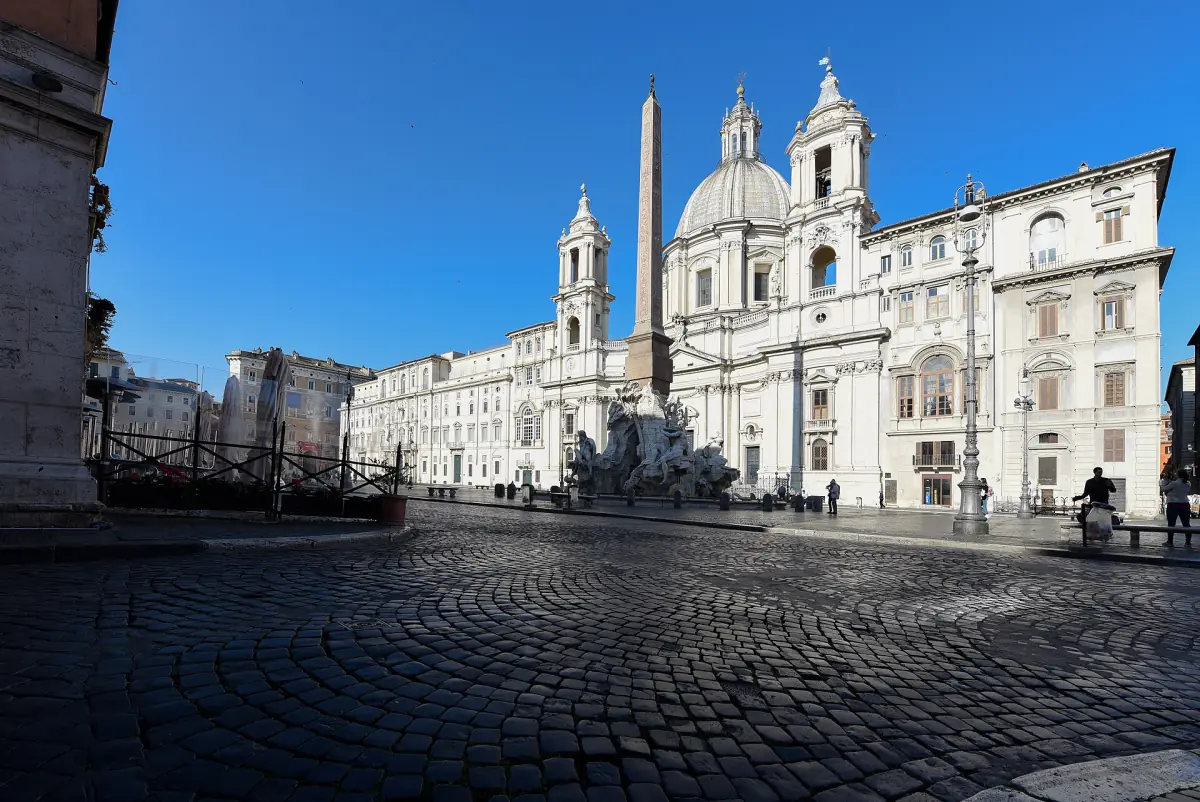
Guided walk with Pantheon entry and Trevi access
Pantheon entry and the Trevi Fountain access ticket are included, along with a 45-minute guided visit inside the Pantheon. A licensed guide leads the walk through Navona and the Spanish Steps.
Check availability →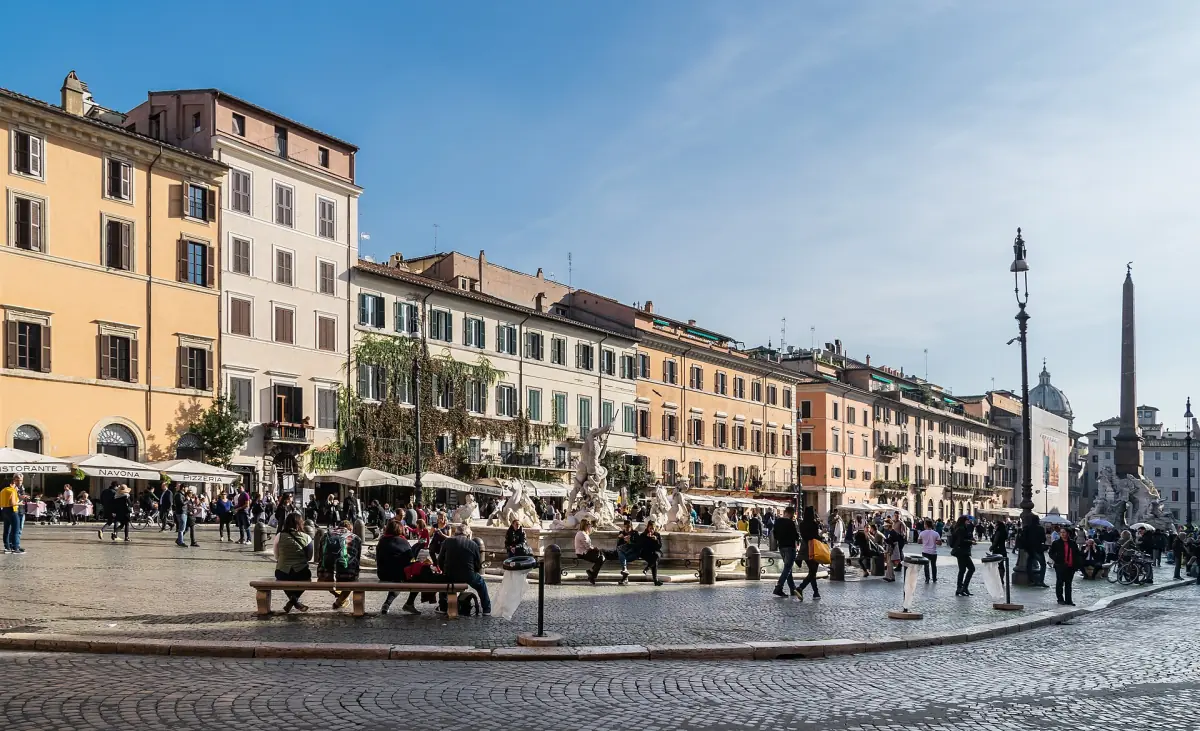
Two-hour walk: Pantheon, Trevi and Navona
A walk with a local guide through the historic centre, ending at the sights around Piazza Navona. Hotel pickup, food, drinks and tips are not included.
Check availability →Tours that pass the fountain
Walking tours of the historic center that stop at Piazza Navona, with live prices and availability.
The obelisk
A Roman work, not an import from Egypt.
The granite obelisk was recovered from the Circus of Maxentius on the Via Appia and put up here with the fountain. It is a Roman work from the time of Emperor Domitian, so it is not an Egyptian obelisk from the age of the pharaohs. Where it stood before the circus is told in different ways, and there is no single story to take as settled. Domitian is also the emperor who opened the stadium that gave the square its shape.
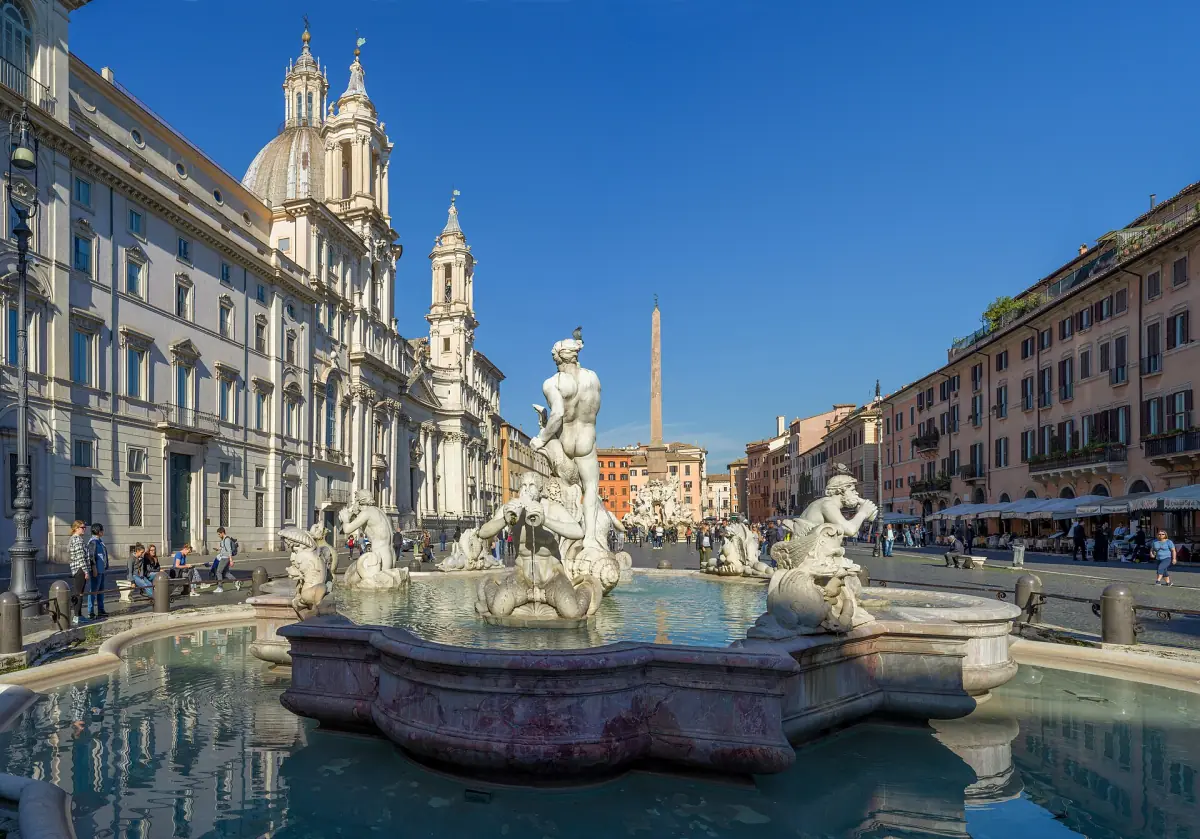
Fontana del Moro
The fountain at the south end of the square. Giacomo della Porta made the basin in 1575. The central figure was made in 1655 by Giannantonio Mari after a design by Bernini. The older figures around the basin were replaced by copies in 1874, so what you see today is partly a 19th-century group.
Neptune fountain
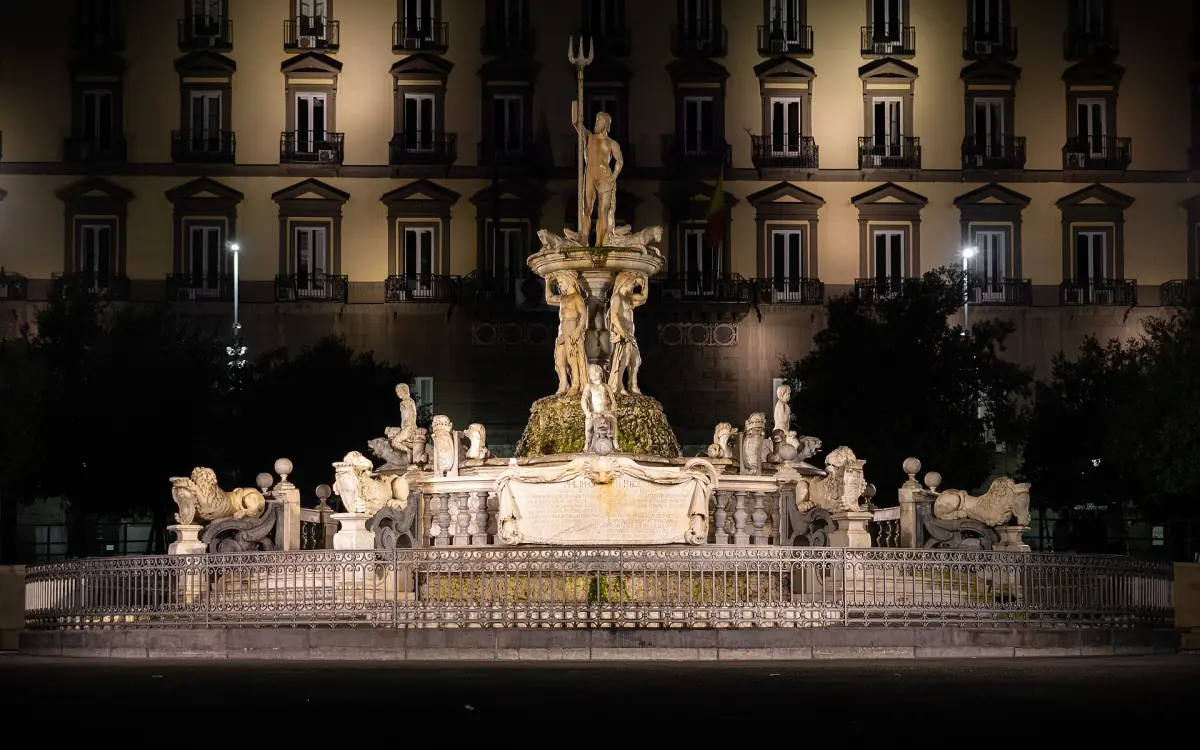
The fountain at the north end of the square. This fountain was once called the Fontana dei Calderari. Giacomo della Porta received the order for the basin in 1574. The sculpture came later, after a competition in 1873: Neptune fighting an octopus by Antonio della Bitta, with the surrounding figures by Gregorio Zappalà. It is not a baroque fountain by Bernini, and it is better read as a 19th-century addition to a 16th-century basin.
Bernini, Borromini and the legend
A good story that the dates do not support.
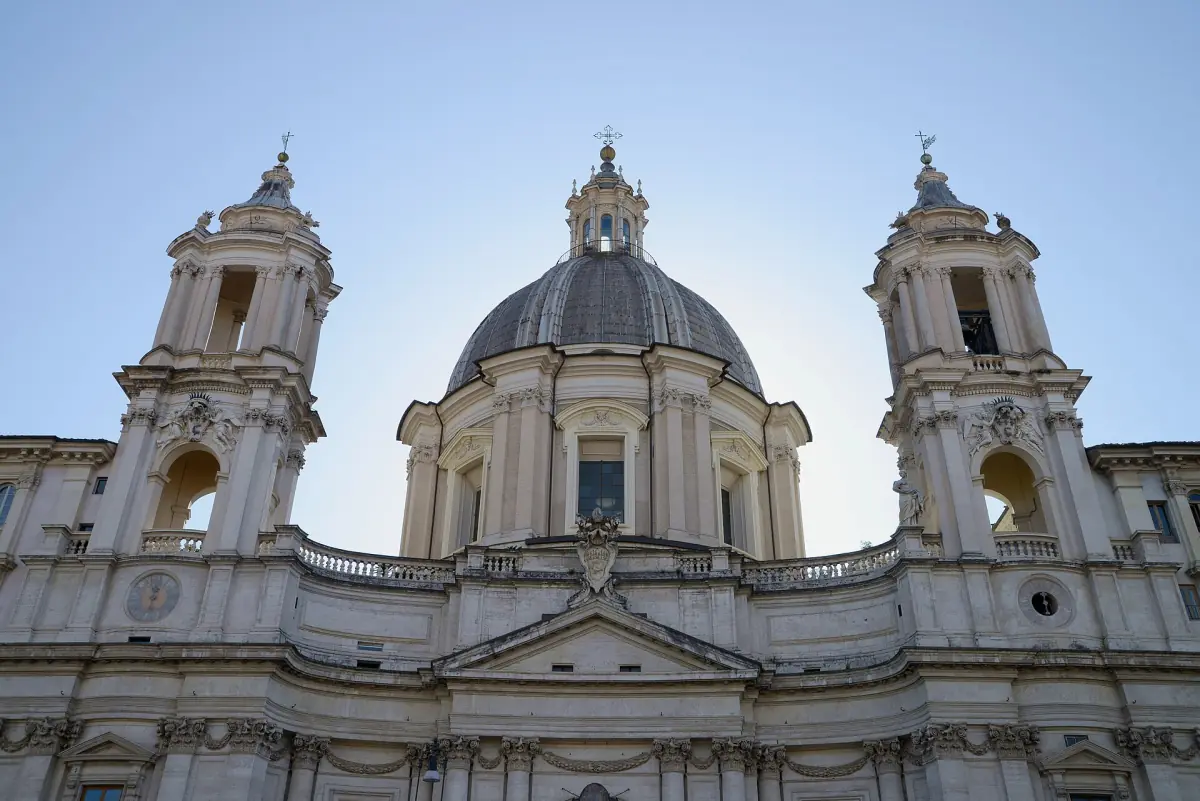
A popular tale says that one of the river figures raises a hand to shield itself from the fall of the church facade opposite, built by Bernini's rival Borromini. It is a legend. The fountain was finished in 1651. Work on the church began in 1652, and Borromini took over in 1653. The fountain stood complete before Borromini had anything to do with the church. Read more on the Sant'Agnese page and in the history of the square.
Restoration and rules at the fountains
What to know when you stand at the basin.
The restoration is finished
The restoration of the Fountain of the Four Rivers is completed. The project ran from 1 June 2022 to 7 April 2025. That does not mean a fence stood around the fountain for the whole time. Photos with scaffolding are from the restoration years.
No bathing, no climbing
City rules forbid bathing in the historic fountains. The stone has limescale and biological films, which are part of the restoration work. Do not touch it, climb on it or step into a basin.
Drinking water
The small drinking fountains (nasoni) in Rome carry drinking water. Do not drink from the monumental basins.
Rome has other famous fountains. For the Trevi Fountain, see the Trevi Fountain page.
Fountain of the Four Rivers: frequently asked questions
Who made the Fountain of the Four Rivers?
Gian Lorenzo Bernini made the design, and several sculptors carried it out between 1648 and 1651 for Pope Innocent X Pamphilj. Not every figure is Bernini's own work.
What do the four rivers stand for?
The Danube stands for Europe, the Ganges for Asia, the Nile for Africa and the Río de la Plata for the Americas. The Nile has a veiled head, and the Ganges holds an oar.
Is the fountain still under restoration?
Restoration is completed; the project ended on 7 April 2025. Photos with scaffolding online are from the restoration years.
Can I touch the fountain or sit on it?
No. City rules forbid bathing, and the stone is fragile. Look from the edge of the basin and keep off the rock and the figures.
Where does the obelisk come from?
It was recovered from the Circus of Maxentius on the Via Appia. It is a Roman work of Domitian's time. Where it stood before is told in different ways.
Are the Moor and Neptune fountains by Bernini?
Only in part. The central figure of the Moor fountain follows a design by Bernini. The Neptune group dates from the 19th century.